194 – Tracheal Stenosis

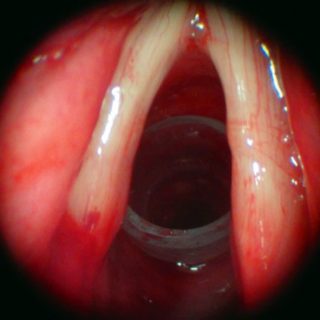
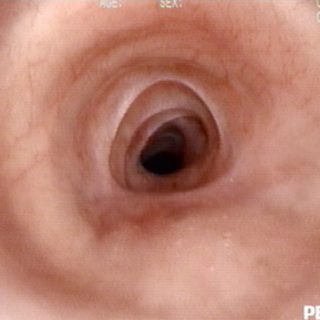
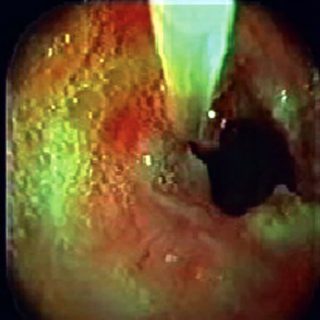
194 - Silicone stent in tracheal stenosis

Silicone stent acting as a support in a tracheal stenosis at the level of the first rings. The vocal cords are somewhat thickened and with obvious congestion in the mucosa in its posterior third, close to the arytenoids.
193 – Tracheal Stenosis

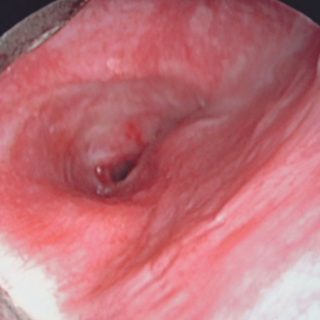
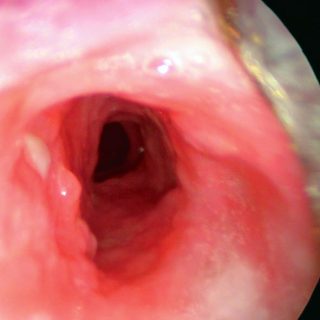
193 - Complex tracheal stenosis

Complex tracheal stenosis after endo-surgical treatment. Image taken one month after a stent, that remained for 2 years, was removed. There is sufficient tracheal light and some changes in its relief due to the presence of granulomas on the left wall. The edema erases the longitudinal folds and the silhouette of the cartilages.

192 – Tracheal Stenosis

192 - Dilation of a tracheal stenosis

Radial cuts at hours 3 and 9, performed with electrocautery. Procedure prior to dilation of a simple tracheal stenosis. The radial cut is also a safety measure reducing the risks of rupture of the posterior membrane during the dilation maneuvers.

190 – Bronchial Stenosis

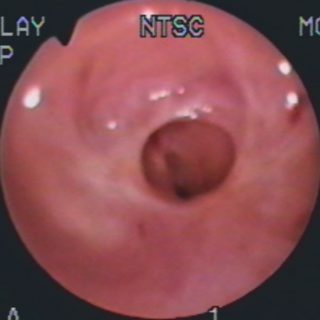
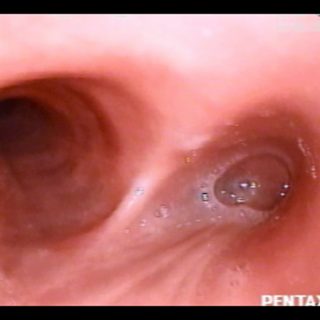
190 - Benign bronchial stenosis

The light from the left source bronchus is greatly reduced due to a stricture established after a complete bronchial rupture due to chest trauma. The reduction of the bronchial diameter is concentric and progressive or “infundibuliform”. The edema thickens the mucosa and the cartilaginous reliefs and also the linear folds of the posterior wall of … Read more

187 – Benign Tracheal Stenosis

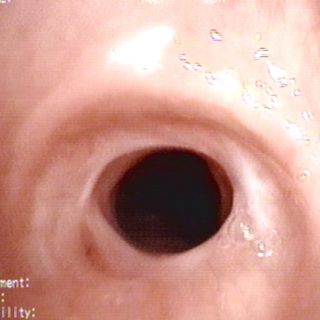
187 - Asymptomatic central stenosis

Consolidated stenosis, central and short, below the prominence of the first tracheal ring. Asymptomatic, because its diameter exceeds 8mm. (Isidoro, R. Prolonged prolonged implant prosthesis: 10 years, RAMR 2016; 3: 250-257)

184 – Subglottic stenosis

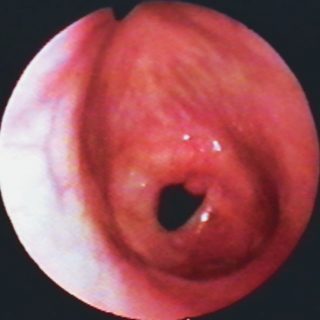
184 - Simple stenosis

Subglottis: at short distance from the vocal cords a simple stenosis, in diaphragm, considerably reduces the light. Ventilation is possible thanks to a central and circular hole, with a small marginal nodule. The same volume of inhaled air must increase its speed to enter through a narrow light, becoming turbulent, which causes visible hyperemia in … Read more