205 – Stents and Stenosis

205 - Local recurrence

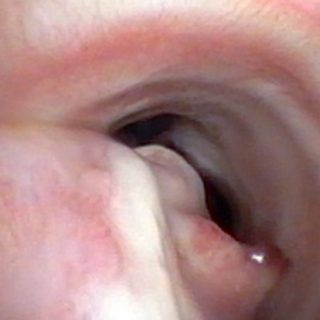
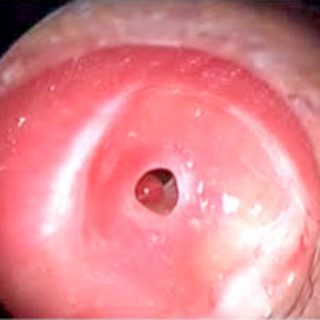
After implanting this “Y” shaped stent, the advance of tumor growth into the stent makes it emerge through its right bronchial branch. As an undesired consequence of the subocclusion of this source bronchus, there is an accumulation of secretions at its entrance, indicating a precarious airflow and an ineffective cough.
203 – Double Stent in Carcinoma

203 - Double bronchial stent

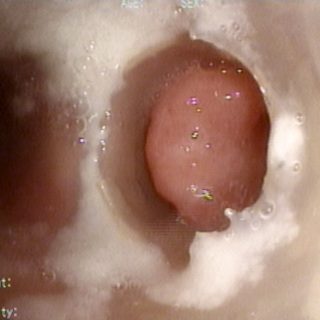
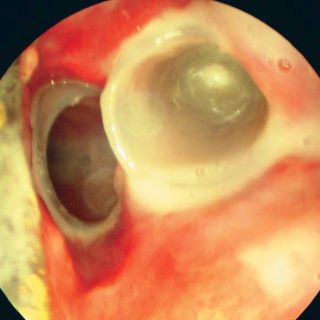
Double stent: after the endo-surgical resection of an extensive carcinoma, two silicone stent were applied in the tracheal bifurcation, leaving the carina “enclosed” between them. In the image, the generalized edema dominates the field and very abundant mucopurulent secretions accumulate around the prosthesis and inside one of them, in which a bubble has formed at … Read more

202 – Tracheal Stenosis

202 - Tracheal mucosa after stent removal

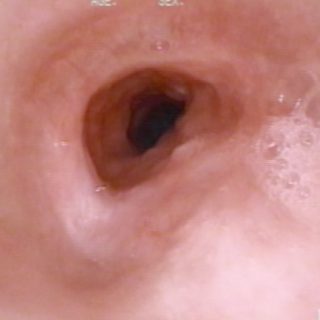
Appearance of the tracheal mucosa after the removal of a stent. There is an arch of residual stenosis, still congestive, and a mucosal bed with bulging edema due to prolonged contact with the prosthesis in that area.

201 – Dilation of Tracheal Stenosis

201 - Dilation of tracheal stenosis with metallic dilator

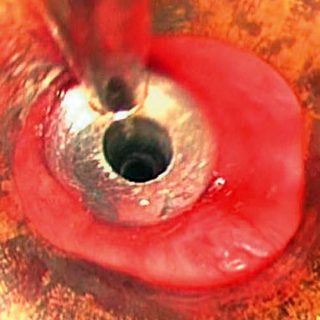
The metallic olive crosses the narrowness of the stenosis gently, forcing the opening of the tracheal lumen. The central hole of the instrument allows the passage of air preventing the complete interruption of ventilation during the procedure.

199 – Dilation of Tracheal Stenosis

199 - Dilation of a stenosis

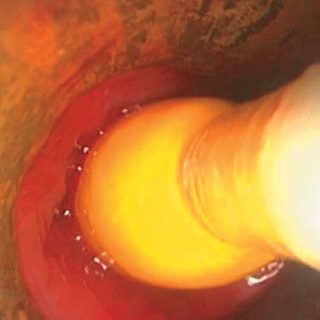
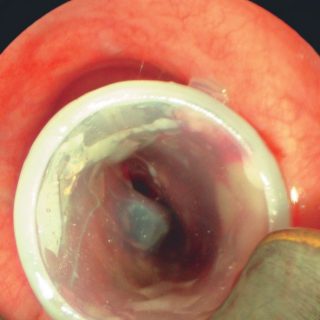
A dilation balloon full of saline solution, exerts circumferential pressure during dilation of a stenosis. The appearance of the tracheal wall, edematous and congestive, can be appreciated after decompression of the elastic balloon. Note the distance between the balloon and the mucosa as a result of the progressive dilation maneuver.

198 – Tracheal Granuloma

198 - Tracheal lesion by cannula tip

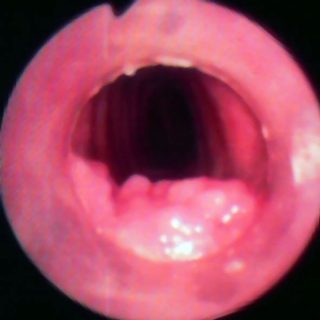
These smooth protrusions that seem to pile on the posterior tracheal wall or mucous membrane, correspond to granulomas originated by a fearsome situation: the “tracheal cannula tip injury”. The lack of stable fixation of the pavilion of the tracheostomy cannula against the neck, allows movements of the device that tends to swing on its support in … Read more

197 – Double Tracheal Stenosis

197 - Double tracheal stenosis

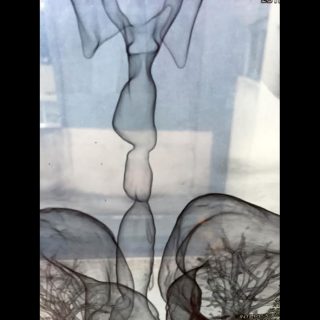
A rare form of complex stenosis is double stenosis. Their treatment differs considerably according to their anatomical location: very separate, close together or even worse, as seen in the reconstruction image: “neither together nor separated”.

196 – Granuloma by Contact

196 - Tracheal stent

Tracheal Stent after 10 months remain implanted. The walls of the endoprosthesis are free of secretions and incrustations, but several granulomas have developed in the mucosa close to its distal end. One, very bulky and bulgy, sits on the entire back wall.

195 – Stent in Tracheal Stenosis

195 - Tracheal stent in unresectable stenosis

“Ideal” position for a tracheal stent in the treatment of unresectable stenosis. The device is “trapped” in the area of the stenosis and its anterior end is “floating” in the tracheal lumen. Thus, this position reduces the possibility of the appearance of granulomas. The distal end of the prosthesis is still somewhat folded. The defect … Read more